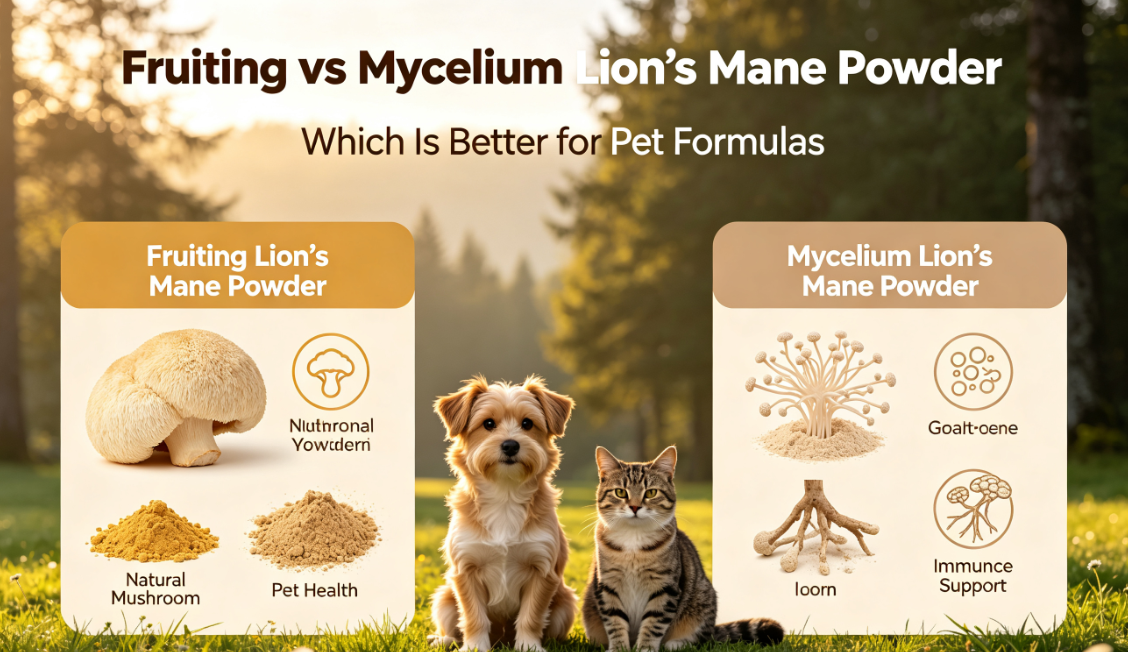
Functional mushrooms have become one of the fastest-growing categories in pet nutrition, with pet food manufacturers and supplement brands increasingly exploring ingredients such as Lion’s Mane, Reishi, Turkey Tail, and Cordyceps for next-generation wellness formulas.
However, one question continues to create confusion among formulators:
Should pet supplements use mushroom fruiting body powder or mycelium powder?
Many discussions simplify the answer into two opposing viewpoints:
- Fruiting body advocates argue that the mushroom body contains higher levels of recognizable functional compounds.
- Mycelium advocates highlight that the fungal network produces unique bioactive compounds not always found in the fruiting body.
The reality is more complex.
A high-quality mushroom ingredient is not defined only by whether it contains fruiting body or mycelium. For pet food manufacturers, the more important questions are:
- What mushroom species is being used?
- Which bioactive compounds are targeted?
- Is the mushroom properly extracted?
- Are potency and purity verified?
- Does the ingredient fit the final pet formula?
For professional pet nutrition brands, choosing the right mushroom ingredient requires understanding the entire fungal lifecycle.
What Are Mushroom Fruiting Bodies and Mycelium?
To understand mushroom ingredients, we first need to understand mushroom biology.
A mushroom is not only the visible structure above the ground.
It consists of several biological components:
1. Mushroom Fruiting Body
The fruiting body is the part most people recognize as a mushroom.
It is the reproductive structure responsible for producing spores.
Examples include:
- Lion’s Mane mushroom “mane”
- Reishi mushroom cap
- Turkey Tail mushroom brackets
The fruiting body commonly contains:
- Beta-glucans
- Polysaccharides
- Triterpenes (especially in Reishi)
- Polyphenols
- Antioxidant compounds
For many mushroom species, fruiting bodies are considered a concentrated source of immune-supporting polysaccharides.
2. Mushroom Mycelium
Mycelium is the underground network of fungal threads called hyphae.
It functions similarly to the root system of plants by:
- Absorbing nutrients
- Breaking down organic materials
- Supporting mushroom growth
Mycelium can contain unique compounds depending on the species.
Examples:
Lion’s Mane Mycelium
Lion’s Mane mycelium is known for containing erinacines, compounds studied for their relationship with nerve growth factor (NGF) pathways.
Turkey Tail Mycelium
Turkey Tail mycelium has been researched for polysaccharopeptides such as PSP.
Cordyceps Mycelium
Cordyceps mycelium may contain compounds such as cordycepin depending on species and cultivation methods.
Therefore, mycelium should not automatically be considered inferior.
Fruiting Body vs Mycelium: A Scientific Comparison for Pet Nutrition
| Category | Fruiting Body Powder | Mycelium Powder |
| Biological role | Mushroom reproductive structure | Fungal growth network |
| Common compounds | Beta-glucans, polysaccharides, triterpenes | Erinacines, enzymes, polysaccharides |
| Cultivation method | Logs, substrates, controlled farms | Fermentation-based cultivation |
| Common use | Immune support formulas | Functional compound-focused formulas |
| Key consideration | Species potency | Cultivation purity and extraction |
| Main concern | Higher production cost | Possible substrate contamination if poorly processed |
The best choice depends on the mushroom species and intended application.
Why “Fruiting Body Only” Is Not Always the Best Answer?
The pet supplement industry has increasingly promoted fruiting-body-only products as a premium quality indicator.
While fruiting bodies can provide valuable compounds, this approach may overlook important scientific differences between mushroom species.
For example:
Lion’s Mane
Lion’s Mane is a perfect example of why species-specific evaluation matters.
The fruiting body contains:
- Beta-glucans
- Hericenones
The mycelium contains:
- Erinacines
These compounds are not identical.
For pet brands developing cognitive support formulas, selecting only one mushroom part may limit the available compound profile.
Reishi
Reishi demonstrates the opposite situation.
The fruiting body is particularly valued because it contains high levels of:
- Ganoderic acids
- Triterpenes
These compounds contribute to Reishi’s reputation as a functional mushroom ingredient.
For Reishi-based pet formulas, fruiting body ingredients are often preferred.
Turkey Tail
Turkey Tail research highlights the importance of mycelium-derived compounds.
Certain polysaccharopeptides have been studied from mycelium cultivation systems.
This demonstrates why a universal “fruiting body is always better” rule is scientifically incomplete.
The Most Important Factor: Mushroom Extraction Technology
For pet food manufacturers, raw mushroom powder quality is only part of the equation.
The challenge is bioavailability.
Mushrooms naturally contain chitin, a structural fiber that can limit digestion of intracellular compounds.
A professional mushroom ingredient supplier should evaluate:
1. Extraction Method
Common extraction technologies include:
Hot Water Extraction
Used to concentrate:
- Beta-glucans
- Polysaccharides
Alcohol Extraction
Used to extract:
- Triterpenes
- Fat-soluble compounds
Dual Extraction
Combines both methods to capture a broader compound spectrum.
2. Active Compound Testing
Premium mushroom ingredients should provide:
- Beta-glucan percentage
- Alpha-glucan testing
- Heavy metal analysis
- Microbial testing
- Residual solvent testing
- Certificate of Analysis (COA)
A pet nutrition brand should never evaluate mushrooms only by marketing claims.
How Pet Food Manufacturers Should Choose Mushroom Ingredients?
When developing functional pet foods, treats, powders, or supplements, consider these five factors:
1. Formula Objective
Different mushrooms serve different formulation goals.
Examples:
| Formula Goal | Suitable Mushroom Ingredients |
| Immune support | Turkey Tail, Reishi |
| Cognitive wellness | Lion’s Mane |
| Healthy aging | Reishi, Cordyceps |
| Energy and vitality | Cordyceps |
| Gut wellness | Functional mushroom blends |
2. Target Animal
Dogs and cats have different:
- Digestive systems
- Feeding behaviors
- Supplement acceptance
Ingredients should be optimized for:
- Palatability
- Dosage
- Stability
- Processing conditions
3. Manufacturing Compatibility
Pet food manufacturers should evaluate:
- Powder flowability
- Heat stability
- Moisture content
- Particle size
- Flavor impact
4. Regulatory Documentation
A reliable mushroom ingredient partner should provide:
- COA
- Specification sheet
- Origin information
- Safety testing
- Manufacturing process documentation
5. Transparency of Mushroom Source
A quality supplier should clearly identify:
- Mushroom species
- Cultivation method
- Mushroom part used
- Extraction ratio
- Active compounds
Zenpet: Functional Mushroom Solutions for Pet Food Manufacturers
At Zenpet, we believe the future of pet nutrition is not based on marketing trends but on scientifically designed functional ingredients.
Instead of promoting a simple “fruiting body vs mycelium” argument, Zenpet focuses on delivering mushroom solutions based on:
Species-Specific Formulation
Different mushrooms have different functional profiles.
Our approach considers:
- Mushroom species
- Desired bioactive compounds
- Final product application
Premium Mushroom Ingredient Selection
Zenpet supports pet food manufacturers with functional mushroom ingredients including:
- Lion’s Mane Mushroom Powder
- Reishi Mushroom Extract
- Turkey Tail Mushroom Extract
- Cordyceps Mushroom Powder
- Functional Mushroom Blends
Quality Control From Raw Material to Finished Ingredient
Zenpet provides:
✓ Batch testing
✓ COA documentation
✓ Microbial testing
✓ Heavy metal testing
✓ Specification sheets
✓ Customized formulation support
Customized Pet Formula Solutions
Whether developing:
- Functional dog treats
- Cat supplements
- Senior pet nutrition products
- Immune support formulas
- Cognitive wellness products
Zenpet helps brands select the right mushroom ingredient format.
FAQs:
1. Is mushroom fruiting body better than mycelium for pets?
Not always. The best choice depends on the mushroom species, target compounds, extraction method, and final formula objective.
2. Can pet supplements contain both fruiting body and mycelium?
Yes.
Many full-spectrum mushroom formulas combine both parts to provide a broader range of mushroom compounds.
3. Is mycelium mushroom powder safe for dogs and cats?
High-quality cultivated mycelium ingredients can be suitable for pet applications when properly manufactured and tested.
The key factors are:
- Clean cultivation
- Proper extraction
- Quality verification
4. Why are beta-glucans important in mushroom supplements?
Beta-glucans are naturally occurring polysaccharides found in many functional mushrooms and are commonly used as quality markers for mushroom extracts.
5. What mushroom is best for senior pet formulas?
Senior pet formulas often combine mushrooms such as:
- Reishi
- Lion’s Mane
- Turkey Tail
- Cordyceps
The ideal combination depends on the formula goal.
Conclusion
For pet food manufacturers looking to create differentiated Lion’s Mane Powder wellness products, Zenpet provides practical mushroom ingredient, designed around formulation performance, transparency, and quality. Contact us today!
References
Wasser SP. Medicinal mushroom science: Current perspectives and future trends.
Standish LJ et al. Mushroom-derived polysaccharides and immune modulation research.
Li IC et al. Lion’s Mane mushroom mycelium and erinacine-related research.
Brown PN et al. Functional mushroom polysaccharides and biological activity studies.
Earth Buddy Pet. “Mushroom Fruiting Body VS Mycelium for Pets.”