





Source bulk probiotic powder for pet food manufacturing. Compare strains, CFU stability, testing, supplier documents, and costs for dog and cat formulas.
Bulk Probiotic Powder: A Procurement Guide for Pet Food Manufacturers
Choosing a probiotic powder manufacturer requires more than comparing price per kilogram. Pet food manufacturers need a defined strain, relevant safety and efficacy evidence, reliable viable counts, and a powder that performs in their actual production process.
This guide explains how to evaluate bulk probiotic powder for dog food, cat food, treats, toppers, and complementary pet products—and how to approach Zenpet with a procurement brief that supports a meaningful technical and commercial comparison.
Planning a project? Request a Zenpet sourcing review with your target species, product format, destination market, and expected order volume.
What Should Manufacturers Look for in Pet Probiotic Powder?
A suitable pet probiotic powder should combine documented microbial identity, safety for its intended use, evidence relevant to the target animal, and viable organisms at the intended dose through the finished product’s shelf life.
Not every fermentation powder or blend of live bacteria meets the scientific definition of a probiotic. ISAPP distinguishes probiotics from other live microbes by demonstrated health benefits and adequate administration levels. [1]
Before requesting a quotation, define:
- Target animal: dogs or cats, including life stage.
- Intended application: kibble, wet food, treats, powder topper, or another format.
- Intended benefit and supporting evidence requirements.
- Manufacturing conditions, including heat, moisture, and addition point.
- Daily serving size and target viable count at expiry.
- Destination market, packaging, and required shelf life.
These inputs help suppliers quote a comparable ingredient rather than an unspecified “high-potency” powder.
How to Evaluate a Probiotic Powder Manufacturer?
1. Verify Strain Identity and Traceability
Request the complete microbial name and strain designation. A species name alone does not establish equivalence to a strain used in a published study.
Ask how identity is confirmed, whether a culture collection accession is available, and how the supplier connects the master culture to production lots. For blends, request identification of every strain and clarification of whether potency is reported collectively or separately.
For EU dossier work, current EFSA guidance addresses strain-level characterisation, whole genome sequencing, and assessment of genes of concern. These requirements are more informative than a generic claim that a species is “safe.” [2]
2. Review Safety and Batch Release Controls
A certificate of analysis (COA) should report actual batch results against agreed specifications. Request supporting methods, sampling plans, and acceptance criteria.
Safety review should address the strain and intended use, relevant contaminants, and potential antimicrobial resistance or virulence concerns. A supplier’s general quality certificate does not establish the suitability of every strain.
3. Confirm Who Manufactures the Ingredient
Clarify whether your counterparty performs fermentation, drying, blending, repacking, or distribution. Map the responsible facilities and ask which site issues the COA.
Request evidence appropriate to the supply chain:
- Manufacturing-site identity and audit information.
- Applicable quality and feed-safety certificates, including their scope and validity.
- Lot traceability, retained-sample procedures, and recall arrangements.
- Change notification for strains, carriers, methods, facilities, or packaging.
- Complaint handling and out-of-specification investigation procedures.
This makes supplier qualification an evidence-based decision.
Bulk Probiotic Powder Specification
The following is a purchasing framework, not a statement of Zenpet product specifications. Numerical limits should be agreed for the selected ingredient, process, and destination market.
| Procurement item | What to request | Why it matters |
|---|---|---|
| Microbial identity | Full name, strain code, identity method, and traceability | Connects the material to safety and research evidence |
| Potency | CFU/g, test method, and guarantee time point | Distinguishes release potency from expiry guarantees |
| Blend composition | Strain list, carrier composition, and potency allocation where measurable | Supports formulation and change control |
| Moisture and water activity | Agreed limits with test methods | Helps evaluate storage and formulation compatibility |
| Microbiological safety | Relevant pathogen and contaminant criteria | Supports batch acceptance |
| Other contaminants | Risk-based heavy metal and other limits | Aligns purchasing with ingredient and market risks |
| Physical properties | Particle size, bulk density, flow, and dispersibility | Supports dosing and blend uniformity |
| Stability | Real-time data under defined packaging and storage conditions | Establishes the limits of shelf-life claims |
| Packaging | Barrier construction, seal, pack size, and resealing instructions | Supports protection during transport and use |
| Documentation | COA, technical data sheet, safety information, and regulatory dossier | Enables internal review and supplier approval |

Probiotic Powder for Dogs and Cats?
Probiotic Powder for Dogs: Match the Evidence to the Application
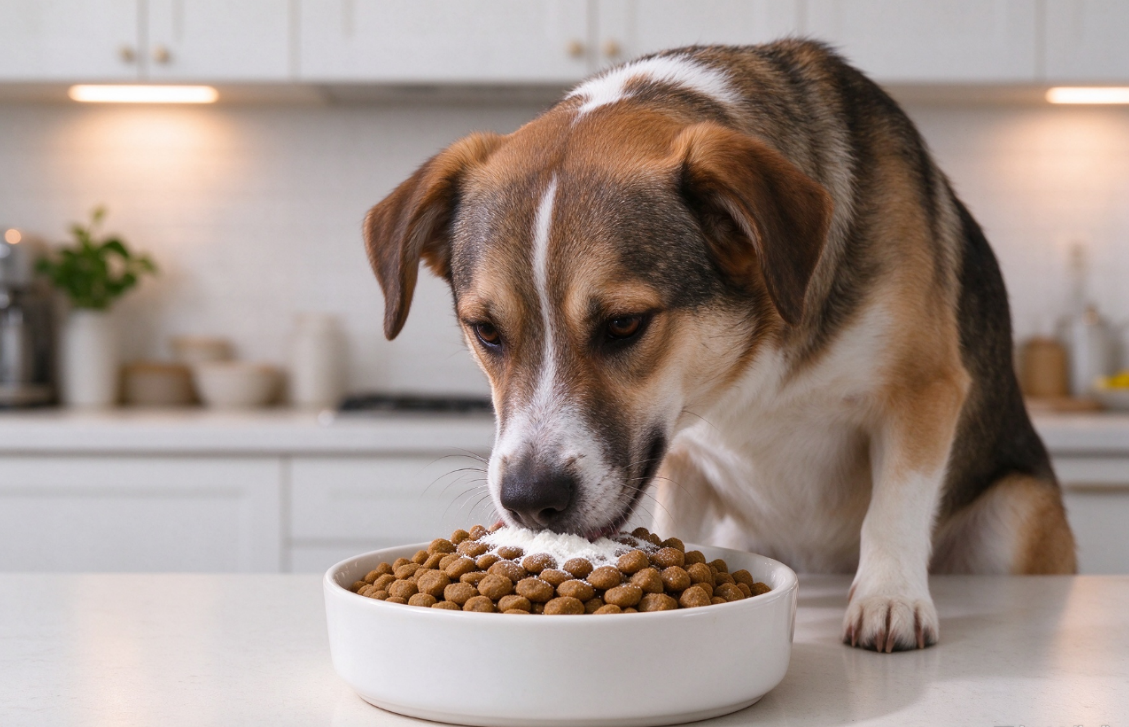
When selecting probiotic powder for dogs, evaluate the exact strain or blend, studied dose, animal population, and measured outcome.
Ask whether the research involved healthy adult dogs, puppies, stressed animals, or dogs receiving veterinary treatment. A study in one population does not automatically support a different product claim.
For procurement, build an evidence matrix that records the strain, formulation, study design, daily dose, duration, outcome, and limitations. Human studies and laboratory assays can provide background, but they do not replace relevant canine evidence.
Probiotic Powder for Cats: Require a Separate Assessment
Probiotic powder for cats needs its own evidence and formulation review. Confirm feline suitability of the strain, carriers, flavour system, daily serving, and finished-product acceptance.
A controlled shelter study of Enterococcus faecium SF68 found fewer cats with diarrhoea lasting at least two days in the probiotic group. It did not detect a significant difference in dogs, where diarrhoea was uncommon. [3]
The purchasing lesson is specific: findings for one strain, species, and setting cannot be transferred to every pet probiotic powder. This study also does not substantiate a claim for an unrelated Zenpet ingredient.
Will the Probiotic Survive Pet Food Manufacturing?
Raw-material potency is only the starting point. Manufacturers should validate viable counts after processing and during storage in the finished product.
| Product format | Questions to resolve before purchase |
|---|---|
| Extruded kibble | Can the selected strain tolerate the actual process? Would validated post-extrusion application be more suitable? |
| Retorted wet food | Can viable organisms survive the thermal cycle? Is a separate dry component feasible? |
| Baked treats | What viability remains after the full temperature and time profile? |
| Soft chews | How do moisture, water activity, preservatives, and processing affect viability? |
| Powder toppers | Are blending uniformity, humidity exposure, palatability, and packaging suitable? |
Some spore-forming organisms may offer processing advantages, but “spore-forming” does not guarantee survival under every process. Request strain-specific data and test the commercial formulation.
A useful qualification sequence is:
- Confirm incoming ingredient identity and potency.
- Run a pilot using representative production conditions.
- Measure viable counts after processing and packing.
- Evaluate stability in the intended packaging.
- Confirm the finished product meets its declared count through shelf life.
Accelerated studies can inform development; they should not be treated as interchangeable with real-time data without a justified predictive relationship.
How to Calculate Inclusion Rate and Compare Cost?
There is no universal probiotic inclusion rate for all dogs, cats, or product formats. Establish a target from relevant evidence and the intended use, then account for manufacturing and storage losses.
For development planning:
Ingredient required per serving (g) = Target CFU per serving at expiry ÷ (Ingredient CFU/g × Processing survival × Storage survival)
For example, assume a hypothetical target of 1 billion CFU per serving, an ingredient potency of 100 billion CFU/g, 80% processing survival, and 50% subsequent storage survival.
Required ingredient = 1,000,000,000 ÷ (100,000,000,000 × 0.80 × 0.50) = 0.025 g per serving.
That equals 25 mg per serving. These are illustrative assumptions, not a recommended dose or validated stability values. A multi-strain product may also need strain-specific assessment rather than a total-CFU calculation alone.
Wholesale Probiotic Powder: Compare Cost per Qualified Serving?
A lower wholesale probiotic powder price may be offset by lower potency, greater losses, or a higher required inclusion rate.
Compare quotations using:
Ingredient cost per serving = Price per kilogram × Ingredient grams per serving ÷ 1,000
Then include testing, freight, packaging, storage, rejected lots, and inventory remaining shelf life. Quote comparisons should use the same strain identity, potency basis, test method, packaging, and delivery terms.
Regulatory Questions to Resolve Before Ordering
For U.S. projects, FDA regulates animal food ingredients, and its direct-fed microbial guidance addresses viable-count guarantees and the effect of promotional claims on regulatory status. Human dietary supplement rules do not provide a separate animal supplement classification. [4,5]
For EU projects, verify the applicable authorisation and conditions for the exact additive, target species, and proposed use. EFSA’s microorganism characterisation guidance informs dossier assessment; it is not itself an authorisation for an ingredient. [2]
Before purchase, have the responsible regulatory team confirm ingredient status, labelling, intended-use claims, and destination-market requirements. Avoid assuming that human-food use, a quality certificate, or a general species listing settles the pet-food assessment.
Discuss Your Pet Probiotic Powder Project With Zenpet
Make Zenpet part of your supplier evaluation by sharing a specification-led sourcing brief. This gives your procurement, formulation, and quality teams a practical basis for reviewing available options.
For a useful quotation, send:
- Whether you need probiotic powder for cats, probiotic powder for dogs, or separate products.
- Product format and manufacturing process.
- Preferred strains or intended evidence requirements.
- Target CFU per daily serving at expiry.
- Destination country and intended claims.
- Pilot quantity, expected annual volume, packaging, and delivery terms.
Ask Zenpet to confirm available strains, manufacturing responsibilities, batch documentation, stability support, sample availability, minimum order quantity, and lead time in writing.
Approve the selected bulk probiotic powder only after its documentation and pilot results meet your requirements. Any claims about Zenpet’s certifications, facilities, capacity, or product performance should be supported by current records for the quoted material.
Request a Zenpet quotation and technical documentation review for your next pet food or pet nutrition project.
FAQs:
Q1:What should I ask a probiotic powder manufacturer before purchasing?
Request strain identity, batch COA, potency methods, safety documentation, stability data, manufacturing-site information, traceability, and change-control procedures. Confirm that the evidence applies to your intended animal and process.
Q2:What is the difference between bulk probiotic powder and wholesale probiotic powder?
“Bulk” generally describes supply in larger quantities or packs, while “wholesale” describes a commercial sales arrangement. Neither term defines potency, quality, suitability, or minimum order quantity. Put those requirements in the specification and quotation.
Q3:Can the same probiotic powder be used for cats and dogs?
Possibly, if safety, evidence, formulation, and regulatory status support both intended uses. Do not assume that canine results establish feline benefits or that both animals require the same serving.
Q4:Is higher CFU always better?
No. The useful target is the viable dose supported for the selected strain and intended outcome. A larger total count does not compensate for poor identity documentation, inappropriate strains, or inadequate shelf-life stability.
Q5:Can probiotics be added before extrusion or retorting?
Only if process-specific validation supports the intended viable count. Evaluate alternatives such as application after heating or a separate dry component where appropriate.
Q6:How should pet probiotic powder be stored?
Follow the selected ingredient’s validated conditions. Confirm temperature limits, humidity protection, transport requirements, and instructions after opening; refrigeration should not be assumed universally necessary or unnecessary.
Q7:How can manufacturers verify shelf-life potency?
Use suitable viable-count methods on representative finished-product lots stored in the intended packaging and conditions. Agree sampling points and acceptance criteria before commercial launch.
References
- ISAPP. What Qualifies as a Probiotic? https://isappscience.org/resource/what-qualifies-as-a-probiotic/
- EFSA Scientific Committee et al. (2025). Guidance on the characterisation of microorganisms in support of the risk assessment of products used in the food chain. EFSA Journal, 23(11), e9705. https://doi.org/10.2903/j.efsa.2025.9705
- Bybee SN, Scorza AV, Lappin MR. (2011). Effect of the probiotic Enterococcus faecium SF68 on presence of diarrhea in cats and dogs housed in an animal shelter. Journal of Veterinary Internal Medicine, 25(4), 856–860. https://pubmed.ncbi.nlm.nih.gov/21689152/
- FDA. CPG Sec. 689.100 Direct-Fed Microbial Products. https://www.fda.gov/regulatory-information/search-fda-guidance-documents/cpg-sec-689100-direct-fed-microbial-products
- FDA. Animal Foods & Feeds. https://www.fda.gov/animal-food-feeds