

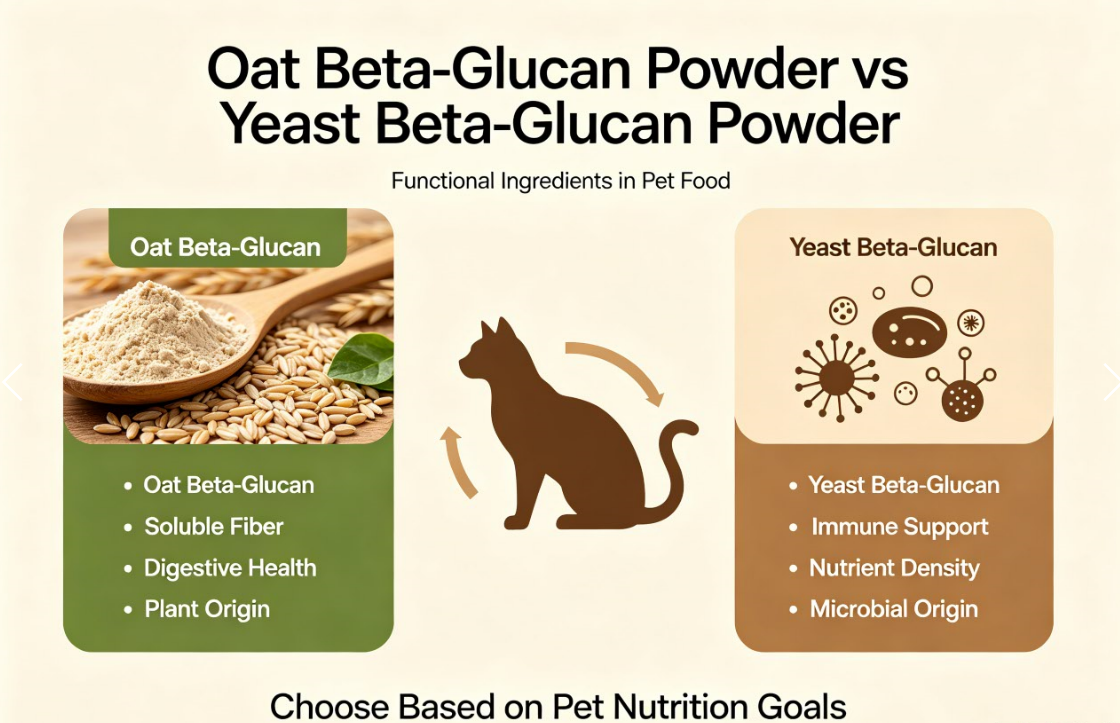
Discover the differences between oat beta-glucan and yeast beta-glucan for pet nutrition. Compare structure, immune support, gut health benefits, formulation applications, dosage, and how Zenpet helps pet food brands develop science-backed functional formulas.
Why Beta-Glucan Has Become a Rising Star in Pet Nutrition?
The global pet nutrition market is shifting from traditional nutrition toward functional, preventive, and longevity-focused formulas.
Pet owners increasingly look for products that support:
- Immune system balance
- Digestive health
- Healthy aging
- Weight management
- Skin and coat condition
- Microbiome health
Among functional polysaccharides, beta-glucan has attracted significant attention because it occurs naturally in oats, yeast, mushrooms, algae, and other biological sources.
However, not all beta-glucans are identical.
For pet food manufacturers, choosing between oat beta-glucan powder and yeast beta-glucan powder is not simply a matter of ingredient preference. The source determines:
- Molecular structure
- Biological activity
- Digestive behavior
- Formulation compatibility
- Marketing positioning
Research shows that beta-glucans from different sources have different structures and physiological effects. Cereal beta-glucans mainly contain β-(1→3) and β-(1→4) linkages, while yeast beta-glucans typically contain β-(1→3) backbones with β-(1→6) branches. These structural differences influence how they interact with digestion and immune pathways.
This article provides a deeper comparison to help pet food brands select the right beta-glucan ingredient strategy.
What Is Beta-Glucan?
Beta-glucan is a naturally occurring polysaccharide composed of glucose molecules connected through beta-glycosidic bonds.
Depending on the source, beta-glucans have different structures:
| Source | Main Structure | Typical Function |
|---|---|---|
| Oat | β-(1→3), β-(1→4) | Soluble fiber, metabolic health, digestive support |
| Yeast | β-(1→3), β-(1→6) | Immune modulation, gut barrier support |
| Mushroom | β-(1→3), β-(1→6) | Immune signaling |
| Algae | β-(1→3) | Gut microbiome interaction |
The biological activity of beta-glucan depends heavily on:
- Molecular weight
- Purity
- Solubility
- Branching structure
- Extraction technology
Therefore, “beta-glucan” is not one ingredient—it is a family of functional ingredients.
Oat Beta-Glucan Powder: The Functional Fiber Solution
Zenpet oat beta-glucan is extracted from oat grain, especially the oat endosperm cell wall.
A typical production process includes:
- Cleaning and milling oats
- Enzyme treatment
- Water extraction
- Filtration and purification
- Concentration
- Spray drying
The final ingredient is usually a light-colored powder containing:
- Beta-glucan
- Soluble fiber
- Natural oat components
Yeast Beta-Glucan Powder: The Immune Health Specialist
Most commercial yeast beta-glucan comes from:
Saccharomyces cerevisiae
Production typically involves:
- Yeast fermentation
- Cell wall separation
- Autolysis
- Beta-glucan extraction
- Purification
- Drying
The ingredient is usually standardized by:
- Beta-glucan percentage
- Particle size
- Microbial purity
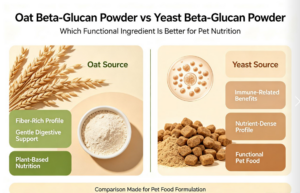
Oat Beta-Glucan vs Yeast Beta-Glucan
| Category | Oat Beta-Glucan Powder | Yeast Beta-Glucan Powder |
|---|---|---|
| Source | Oat grain | Saccharomyces cerevisiae yeast |
| Main Structure | β-1,3 / β-1,4 | β-1,3 / β-1,6 |
| Primary Positioning | Digestive & metabolic health | Immune support |
| Fiber Function | Excellent | Moderate |
| Immune Modulation | Moderate | Strong |
| Gut Microbiome | High potential | High potential |
| Weight Management | Strong | Moderate |
| Premium Pet Supplement | Good | Excellent |
| Functional Treats | Excellent | Excellent |
| Powder Supplements | Excellent | Excellent |
| Marketing Story | Plant-based wellness | Science-backed immune support |
Can Pet Brands Combine Oat Beta-Glucan and Yeast Beta-Glucan?
Yes. A combined formula can provide complementary benefits:
| Ingredient | Function |
|---|---|
| Oat Beta-Glucan | Soluble fiber + metabolic support |
| Yeast Beta-Glucan | Immune modulation |
| Prebiotics | Microbiome support |
| Probiotics | Digestive balance |
| Mushroom Extract | Advanced immune positioning |
Which aligns with current trends in premium pet nutrition.
Is Oat beta-Glucan Safe for Dogs?
Yes. Oat beta-glucan has been studied as a dietary fiber ingredient in dogs and may support digestive and metabolic health when used appropriately.
Dog Food
Applications:
- Dry kibble
- Wet food
- Freeze-dried meals
- Functional treats
Pet Supplements
Formats:
- Powder toppers
- Capsules
- Soft chews
- Functional snacks
Why Pet Food Manufacturers Choose Zenpet Beta-Glucan Solutions?
At Zenpet, we understand that pet brands need more than raw materials.
They need:
- Stable supply chains
- Consistent specifications
- Formulation support
- Market-ready ingredient solutions
Our beta-glucan ingredient solutions are designed for:
✔ Premium dog food manufacturers
✔ Functional pet supplement brands
✔ Private label pet nutrition companies
✔ Veterinary wellness product developers
Zenpet Quality Standards
Our ingredient development focuses on:
1. Ingredient Authentication
Testing includes:
- Identity verification
- Beta-glucan content analysis
- Microbial testing
2. Formulation Compatibility
Solutions available for:
- Powder supplements
- Functional treats
- Pet food premixes
Zenpet helps pet nutrition companies transform functional ingredients into commercially successful products through reliable sourcing, formulation expertise, and science-driven solutions.
Conclusion
Sourcing Oat beta-glucan powder for your brand? Talk to the team that’s supplied the industry’s leading brands for over 20 years. Every Zenpet sample ships with third-party verified analysis, Evaluate it against anything on the market. Contact us today!
References
Oat beta-glucan as a dietary supplement for dogs. PLOS ONE.
Beta-glucan sources and their differences for animal nutrition. Journal of Animal Science.
Evaluation of a yeast β-glucan blend in pet food application. Frontiers in Animal Science.
Beyond Immunity: Functional Outcomes of Dietary Yeast and Seaweed β-Glucans in Adult Canine Nutrition. Journal of Animal Physiology and Animal Nutrition.
Alternative Dietary Fiber Sources in Companion Animal Nutrition.